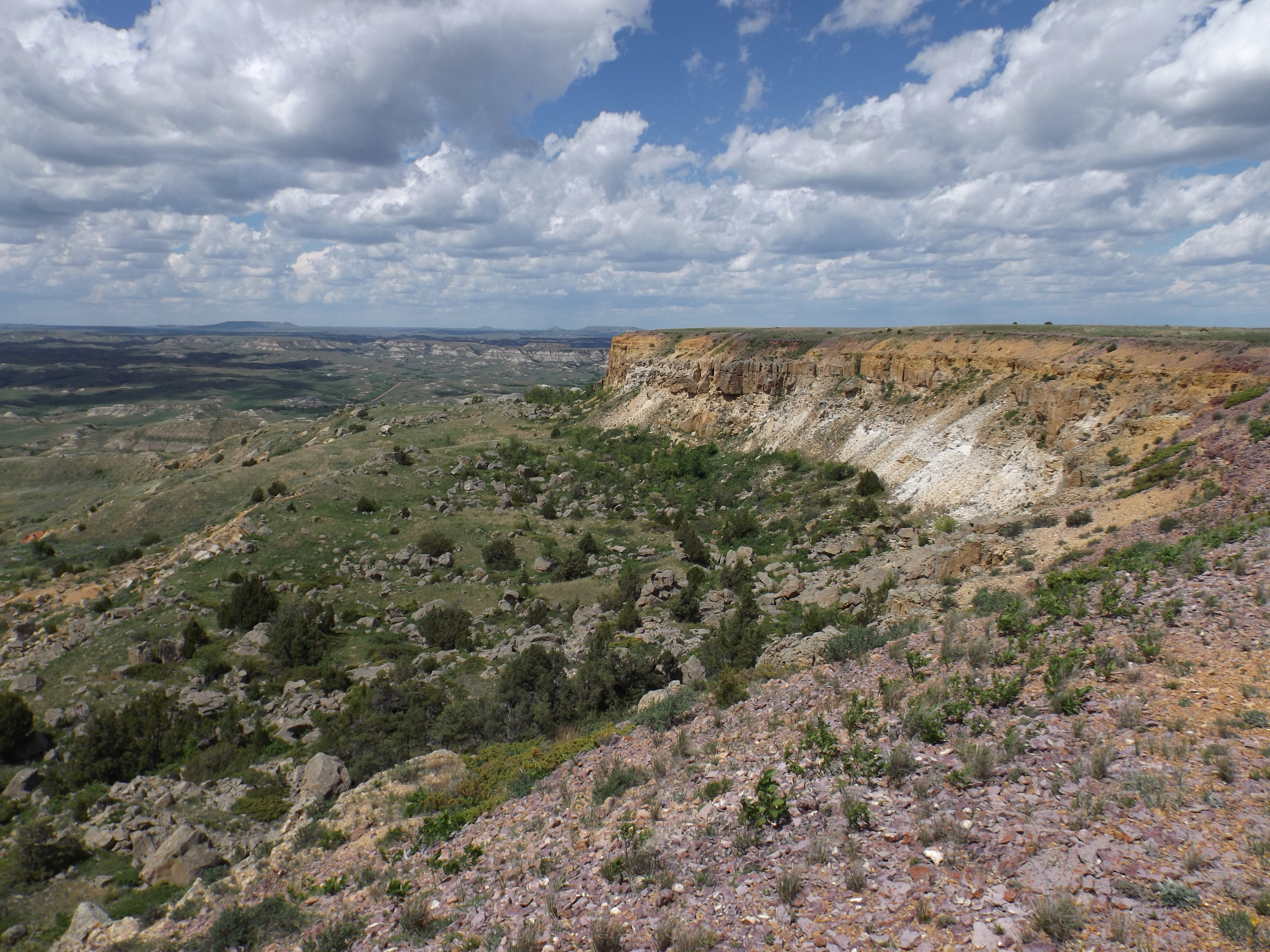

Today I want to share with you something my friend Clay Jenkinson, a learned man and lover of the West and its Prairies, wrote in response to some actions being taken by the Trump Administration through its Sectetary of Interior Doug Burgum, a former Governor of ours.
I voted for Doug Burgum once, in the Primary Election of 2016, one of the very few times, maybe even the ONLY time, I voted in the Republican column in a North Dakota Primary Election.
I voted for Doug Burgum for Governor in that 2016 Primary Election for one reason: to save the North Dakota Bad Lands from Wayne Stenehjem. At the time, Stenehjem was our Attorney General, and he was up to his eyeballs in a lawsuit against the federal government. Stenehjem sought to allow the state of North Dakota and four counties in western North Dakota to go in and build roads on some lands in our Bad Lands that were protected as “roadless areas” by the federal government. The roads would allow oil companies to go in and begin drilling on some of our most valuable near-wilderness areas.
Clay and I had been in to see Stenehjem, who we both counted as a friend, to plead with him to drop his lawsuit and leave the roadless areas unroaded. He gave us the lamest excuse ever for what he was doing: State Sovereignty. Clay and I said were were pretty sure most North Dakotans didn’t give a “rat’s ass” about state sovereignty.
Then he tried to make the move across the hall from the Attorney General’s office to the Governor’s office. Burgum stopped him. And Drew Wrigley, who succeeded him in the AG’s office, eventually just dropped the lawsuit after losing in an appeals court.
Burgum won that election to become Governor in 2016. I’d have preferred a Democrat, but I had hopes for Burgum to be a good caretaker of the office. In fact, shortly after he took office I wrote this about him on my blog:
“Doug Burgum is a lot smarter than me. So I’m not going to use this space to tell him how to run North Dakota. He’ll figure that out. I haven’t been this confident in a governor since Ed Schafer left office.”
Burgum treated the Bad Lands fairly well–he owned a ranch out there and really, at one time, did love those Bad Lands–but he got stepped on and persuaded by the oil boys from time to time, and treated them fairly well too. I thought, in the end, though, that the Bad Lands probably got treated better by Burgum than they would have under Stenehjem.
And then Doug decided to run for President of the United States. He didn’t win, but he got picked to be the Secretary of the Interior, the person responsible for protecting most of America’s Public Lands. If the OLD Doug Burgum was still around, that might have been a good thing. But we got a NEW Doug Burgum once he got to Washington and fell under the spell of Donald Trump. And now he’s doing his best–I’m sure you have been reading about it–to turn all those public lands he once loved into an industrial wasteland.
And that’s what Clay wrote about this week in his weekly essay on his “Listening To America” website. It’s as fair-minded and rational a defense of public lands in the West as I’ve ever seen. Here, read it for yourself. I don’t think Clay will mind me stealing it from him and sharing it with you.
________________________
A Struggle for the Public Commons: Buffalo, the Department of Interior & American Prairie Reserve
Tuesday, January 20 2026
Clay reflects on a recent announcement from the U.S. Department of the Interior to revoke bison grazing leases from American Prairie, an organization that has long been working to establish a buffalo wildlife reservation in Northern Montana.

The U.S. Department of the Interior announced last week that it is revoking seven bison grazing leases in Phillips County, Montana, managed by the nonprofit organization American Prairie. American Prairie (formerly called American Prairie Reserve, APR), founded in 2001, is seeking to create the largest wildlife preserve in the continental United States in north-central Montana. The project seeks to knit together 3.2 million acres of public and private land in one of the least densely populated regions in America to establish a wildlife reservation that will eventually support up to 25,000 bison — and a wide range of other Great Plains wildlife species. The APR’s carefully crafted management plan was approved by the Bureau of Land Management (BLM) in 2022, specifically permitting bison restoration.
In December 2025, the Secretary of the Interior Doug Burgum (formerly the governor of North Dakota) announced his decision to review the APR’s grazing permits. Under the provisions of the Taylor Grazing Act of 1934, Burgum argued, the public lands are required by law to support production agriculture (i.e., cattle grazing), not wildlife conservation. Secretary Burgum’s decision is just one gambit in the Trump administration’s plan to privatize some public lands, reduce the size of several National Monuments, give states greater control over management of federal lands within their boundaries, permit and encourage greater resource extraction on the public domain, and ease land use regulations. In other words, the Trump administration is implementing many of the provisions of Project 2025, the non-governmental Heritage Foundation’s blueprint to reverse decades of public lands policy in favor of an anti-conservation, pro-oil, pro-gas, pro-coal, pro-uranium, and pro-grazing regimen in the American West (and Alaska). So far, the lease revocation only impacts BLM lands, those embraced by the Upper Missouri River Breaks National Monument, but it is clear that the United States government is now determined to damage the American Prairie project as much as possible.
Let’s Be Clear About the Law
It might be useful to make clear that the public lands of America belong to all the people of Montana, all the people of the United States, not just the ranches in the region, not just the cattle industry, not the mineral extraction corporations. Cattle grazing is a legitimate use of public lands. So is carbon extraction. So is recreation. So is conservation. The politicians of some Western states have gotten into the bad habit of thinking America’s public domain belongs mostly to them. This is simply not true. Many cattlemen believe that the acreage we Americans permit them to graze on (usually at below-market prices) somehow belongs to them. But it doesn’t. Most of the American West is, as they say, open for profitable business. Still, it should be possible for us (we the people) to sequester a few parcels of this vast continent for non-profit uses, for commonwealth uses. However unpleasant this is to hear, I have as much right to have a voice in public lands policy near Malta, Montana, as a heritage rancher. No more and no less. I am glad those ranches exist, and I want them to continue to have access to BLM and other public lands. But I do not want them to pretend that they know best how we should manage America’s outback.
Secretary Burgum’s Decision

Doug Burgum would be precisely the Secretary of the Interior who could make the case for seeing the American Prairie’s extraordinary project to its goal — to assemble the largest bison herd in North America on some private and mostly public land where it might be possible for a buffalo to live its whole life without encountering a fence or a vehicle. Mr. Burgum is a very wealthy businessman, formerly a moderate Republican, an outstanding administrator, and a creative and forward-thinking politician. In my view, he is probably the most competent person in the Trump II cabinet.
In addition to that, though he grew up in the most lucrative agricultural zone in North Dakota — the Red River Valley — Burgum spent a significant portion of his young life out in the badlands of western North Dakota on one of the most beautiful ranches in the American West. He wants to be known as a lover of western landscapes, as a good steward of public lands, as someone whose character and outlook were partly forged out along the Little Missouri River, in Theodore Roosevelt country. The U.S. Department of the Interior has a broad conservation mandate. If Burgum loves the Western landscapes as much as he wishes us to believe, you’d expect him to regard the American Prairie as an intriguing and ingenious initiative — to restore a bit of American Serengeti in a portion of Montana where human outmigration has been the central social dynamic for the last 90 years.
Burgum claims a close association with Theodore Roosevelt, the 26th president, who played cowboy and rancher in the North Dakota badlands for half a dozen years starting in 1883. As president, Roosevelt set aside 230 million acres of the public domain as National Parks (5), National Monuments (18), National Game Preserves (4), National Forests (150), and National Wildlife Refuges (51). Roosevelt killed his first buffalo just west of the Little Missouri River in September 1883, not far from the ranch Burgum knows best. When Roosevelt realized that the bison (America’s greatest quadruped) was in grave danger of becoming extinct, he devoted some of his enormous energy (and political capital) to saving the buffalo, in association with William Hornaday, Charles Goodnight, George Bird Grinnell, Scotty Philip, Walking Coyote (Salish–Pend d’Oreille), and Michel Pablo (Salish–Pend d’Oreille).
Theodore Roosevelt would be thrilled at the prospect of an American Prairie that could serve as a sanctuary for buffalo, bighorn sheep, pronghorn antelope, elk, prairie dogs, mule deer, coyotes, and probably grizzly bears, mountain lions, and wolves, too. No interpretation of Roosevelt’s lifelong conservation ethic can be distorted to suggest that he would oppose the American Prairie. No president did more for the sensible conservation of what is most magnificent in our western landscapes. In fact, the American Prairie is conservation on a Rooseveltian scale!
Secretary Burgum is precisely the sort of leader who should defend and encourage the American Prairie initiative. As a Republican of the American West, the former governor of a conservative state, a proven advocate of efficient government and good management (in other words, he ain’t no tree-huggin’ liberal or environmentalist), he has the credentials to persuade the reactive Sagebrush Rebellion types (including the Montana governor and the state’s congressional delegation) that the Prairie Reserve will be a great thing for Montana and the West. Burgum could be to American Prairie what Richard Nixon was to rapprochement with China in 1972 — someone whose credentials could never be questioned by political conservatives and whose vision must be taken seriously.
Instead, Mr. Burgum has determined to give his soul to some of the most pro-development dynamics of American life. He’s better than this. I know him.
Size Matters – A Postage-Stamp-Sized Parcel of Montana

Even at its most ambitious, the American Prairie would take up only a postage-stamp-sized parcel of Montana. If the project achieved its full potential, it would have a total footprint of approximately 3.2 million acres, with about half public and half private. That’s about the size of the state of Connecticut. Impressive, but Montana is so vast that you could put 26 Connecticuts within its borders with a few hundred thousand acres to spare. In that vast footprint of Montana’s least-visited region, the human population does not exceed 5,000 people, and none of them — NONE — would be displaced unless they choose to sell their ranches to American Prairie at above-market prices.
Much of the Prairie Reserve would be located in the Upper Missouri River Breaks National Monument and in the Charles M. Russell National Wildlife Refuge. The rest of the needed land is being purchased from private ranchers and landowners (willing buyer + willing seller = the American Way!). But only when they decide to sell. What better use of a National Monument and a National Wildlife Refuge than to provide wildlife habitat for somewhere between 5,000 and 30,000 buffalo and other grassland creatures? Whose ox is gored? The American Prairie visionaries cannot (and do not wish to) condemn private land, force sales, pressure landowners, or confiscate any private property whatsoever in Montana. In addition, the American Prairie’s enlightened staff works closely with friendly ranchers and communities in the region to market their beef, build their brands, encourage American Prairie-related businesses, and collaborate in times of crisis.
“The Heart of the Matter” — How Some Montana Ranchers View the American Prairie
I have had the pleasure of spending time with ranchers in east-central Montana, many of whom are hostile to the American Prairie project. I respect them greatly. They are often the heirs of the “giants in the earth” who settled eastern Montana in the 1880s–1920s, the heritage ranchers who proved up and gutted it out on a forbidding sub-arctic landscape far from the centers of population, capital, markets, transportation, and the finer amenities of life. They have survived killer blizzards (1886) and the greatest drought in American history (1933–1940). They get up in the night to help birth (pull) calves when it is 30 below zero. When their neighbors are in need of immediate help, they show up every time. They have exhibited “the right stuff” again and again in their family narratives, in a land of adversity that wealthy individuals from elsewhere could never endure. They hold a special place in the American frontier story.
It’s not easy to understand their hostility, but from what I have heard and read, it looks something like this:
– This project will lock up the lands in question.
– This will diminish the already strained tax base in the affected counties.
– The outsiders (they are NOT Montanans) who are funding this initiative don’t know a heifer from a housefly. They glide in on their private jets, make no attempt to hide their contempt for rural people, and have deep enough pockets to outbid neighboring ranchers who might wish to purchase the ranch properties that come up for sale.
– The federal government should not play favorites. There is already too much federal control in Montana and the American West. The last thing we should do is let the feds throw their support behind the detested “Buffalo Commons” proposal that Poppers (Frank and Deborah) of Rutgers University envisioned back in 1987.
Each of these arguments can quite easily be refuted. For example, rather than diminishing the regional economy, the American Prairie will almost certainly be the biggest economic boost this marginal region has ever experienced. Millions of people from all over the world will visit the great buffalo grounds, and they will inevitably leave a great deal of clean money behind. Even a modest increase in hotels, restaurants, coffeehouses, boutique shops, fuel stops, guiding services, and outdoor recreation stores will make the counties and communities in question among the most successful economic hotspots in rural America.
When I have listened to the concerns of the local people, and especially the ranchers, I have sensed that the critique outlined above is not the heart of the matter. I use the term “heart of the matter” purposefully. The sense I get is that the American Prairie plan feels to them like a threat to, and a negation of, their Way of Life — a heritage deeply rooted in Montana history and mythology. I remember one rancher saying something approximating this: “My family has been on this land for five generations. It has been a good life, but it has involved a great deal of hard work and sacrifice. We don’t get rich, but we love it here. We have stuck it out through thick and thin. Now, a bunch of rich liberal outsiders who have no idea what it takes to live here roll in with their fat checkbooks, and they are going to take over and impose their values on us. It makes us wonder what our heritage has meant if it can be extinguished by privileged people who would never have homesteaded out here. They don’t spend the winter here. We do.”
A Society to Match the Scenery?

I understand that. And I deeply respect their point of view. But the truth is, almost every ranch I know (mostly in my own North Dakota) is facing a succession crisis. Many of the children of ranchers, and especially the grandchildren, don’t want to live out there anymore. They want the amenities, mobility, and access available in Denver, Spokane, or even Billings and Butte, for that matter. The American Prairie is deeply respectful of heritage ranching and the traditional way of life in east-central Montana. But when a ranch in its target zone comes up for sale, and a member of the extended ranch family does not wish to bid on it, American Prairie stands ready to make the purchase — not to get rich or extract anything from the soil, but to make possible an even deeper grasslands heritage. If American Prairie succeeds, and I believe it will succeed even against the opportunistic retributions of the Trump administration, it will be one of the greatest tributes to the American West that Lewis and Clark encountered in 1804–06, and an even greater tribute to the Indigenous peoples who lived on these grasslands for thousands of years and for whom the buffalo was the absolute center of their economy, their social structure, and their spiritual lives. Surely we are a people big-souled enough to set aside a small and very sparsely inhabited fraction of Montana (3%) as a reservation for the primordial ocean of grass and its indigenous creatures that have proved to be one of the single most potent sources of the Idea of America. The Frontier. The Garden of Eden. American Serengeti. The American West.
The late Wallace Stegner loved the West so much that he demanded that we try to create a “society to match the scenery.” The beef cow is an ungulate. A buffalo is a much nobler (and native) ungulate that resonates with the deepest mythologies of American memory.
At one time, there were perhaps as many as 60 million bison in North America. By the time William Hornaday and Theodore Roosevelt stepped in to save the majestic species, there were no more than 500 bison left on earth. Today, there are more than 450,000 buffalo in America: ~420,000 in commercial/private herds, ~25,000 on Indian reservations and ~5,500 in National Parks (chiefly Yellowstone), other public lands and conservation areas account for ~6,600. Their habitat once extended from the Rocky Mountains to the Appalachians, from Edmonton, Alberta, to the Gulf of Mexico. We should all want them to have a postage-stamp sanctuary on the northern Great Plains.
There is still time to get this silly and retributive policy reversed. But it will take a concerted effort by those who believe a modest buffalo commons has a legitimate place on America’s public lands. What the American Prairie wants to preserve for all of us is one 200th of the public domain.
Seems reasonable to me.
 The Prairie Blog