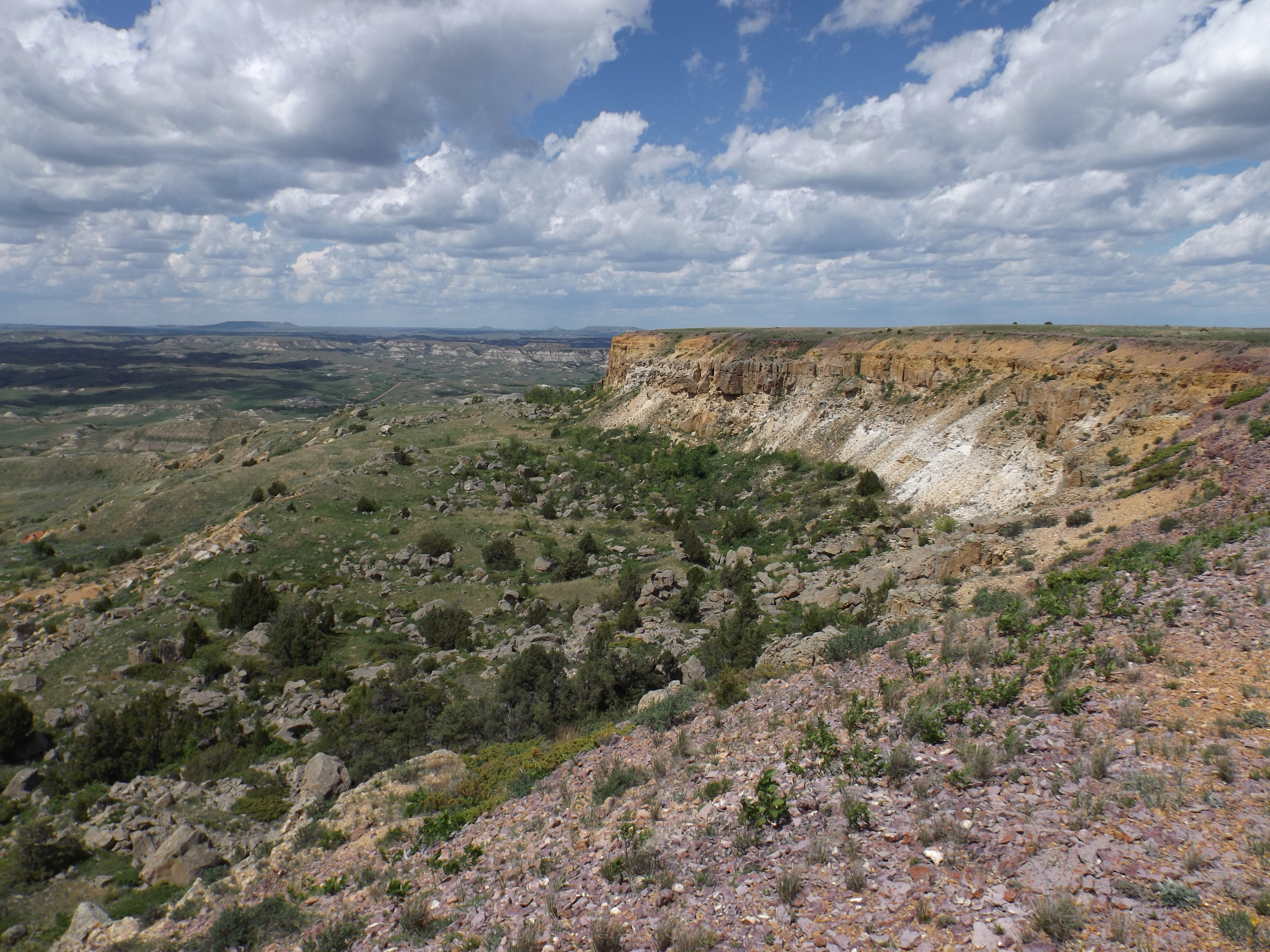

I love the North Dakota Bad Lands. And the million acres of our National Grasslands that surround and encompass them in Western North Dakota. I especially love the one-fourth of those million acres that are protected from development, and left for the many species of wildlife that live there, by the USDA’s Roadless Area Conservation Rule, commonly just called the Roadless Rule.
Now those roadless areas of the Grasslands, and the rule that protects them, are under attack. By the very agency that promulgated that rule just 25 years ago. I can remember the day we first found out it was really going to happen, back in early 2001. The rule was one of the last gifts we received from President Bill Clinton, who published it in the Federal Register January 12, 2001, just a little over a week before he left office.
I remember being caught a little bit off-guard, because it affected me personally. Because it said I could no longer drive to the top of my favorite place in the Bad Lands, favorite place in the WORLD, for that matter. Bullion Butte. Something I had done a few times before the rule took effect.
In those days, we would often drive to the Logging Camp Ranch, stop and visit with our friends the Hansons, then drive through their pasture on one of their trails, then down into Hanley’s Wash, on a spooky two-track trail where we could see ahead of us a little ways, behind us a little ways in the rear view mirror, but we couldn’t see anything on either side until we emerged from the Wash at the base of Bullion Butte. Then we found the narrow, rugged, two-track trail up the side of the butte, emerging on top with the most spectacular view in all the world, as far as I am concerned. If you want to see one of those views, scroll up to the top of this page and take a look at my cover photo, one of the photos I shot when I was up there one day. See what I mean?
We weren’t the only ones who drove up there. It’s North Dakota’s largest butte, and hunters shot deer and wild birds up there, and ranchers ran cattle up there, on a lease from the Forest Service, which owns the butte. There were water tanks and some feed bunks, as I recall. Once we even came across an old bathtub sitting out in the middle of the large prairie atop the butte.
And so the Roadless Rule put an end to driving up Bullion Butte. I had hiked to the top once, a few years earlier, when the first number in my age was 4. I’ve added a few numbers since then, but I’ve managed to climb it on foot many more times than I drove up. I quickly learned that hiking up is waaaay better than driving up. There is much to see and enjoy along the way—and we’ve taken a few different “ways” until settling on the best one going each direction. We’ve also learned some we will never, ever, try again.
It’s pretty much a full-day adventure, starting from the Little Missouri River bank on Bud Griffin’s ranch, spending a couple hours (seriously–the first number in my age is 7 now, soon to be 8) winding our way to the top on the butte’s northeast side, then slowly circling the entire perimeter on top, about a mile hike, stopping to hang our legs over the sheer cliff on the west side and eat lunch, then carefully climbing back down on the butte’s north face, pausing at a couple water holes on the side of the butte, and finally ending up back at our vehicles parked beside the Little MO, just outside the roadless area.
But I digress.
Because what I really want to say is, I am perfectly willing to let that road through Hanley’s Wash, and up the side of Bullion Butte, remain off limits. Because there are so many other wonderful protected places in the Bad Lands, places like Kendley Plateau, Long X Divide, and Twin Buttes, I will do most anything I can do to play at least a small part in preserving the U.S. Forest Service’s Roadless Rule. Anything, short of saying “Screw you, Donald Trump.” Well I might say that too.
Here’s some basic background. Some I just copied from other sources, some is my own research and feelings.
When President Clinton issued the Roadless Area Conservation Policy directive, he ended virtually all logging, roadbuilding, and coal, gas, oil, and other mineral leasing, in some of the wildest remaining undeveloped lands in America.
The Rule was the direct result of a tremendous outpouring of public support. More than 600 public hearings were held around the nation, and the public provided more than 1.6 million comments on the Rule—more comments than any other rule in the nation’s history.
The Roadless Rule is one of America’s most successful conservation measures. It protects drinking water, wildlife habitat, and world-class recreation opportunities across 58.5 million acres of national forests and national grasslands. Including a quarter of a million acres in North Dakota.
But now the lackeys who run the agency that manages most of our public lands, the U.S. Department of Agriculture, say the Roadless Rule has to go away. Here’s their logic, extracted from their posting in the Federal Register last week, on August 20, 2026, exactly 25 years, 7 months and 8 days after its first posting for implementation in the Federal Register in 2001. This is from the current Agriculture Secretary, Brooke Rollins:
“Given changing resource conditions and shifts in policy priorities, the Department believes that the “one-size-fits-all” approach to roadless area management under the 2001 Roadless Rule is no longer appropriate and proposes to use local land management planning processes to administer inventoried roadless areas. Rescinding the 2001 Roadless Rule would provide discretion for local land managers to tailor management, as appropriate, to local land conditions.”
How different than what Agriculture Secretary Dan Glickman wrote in 2001:
“Demands for, and supplies of, renewable resources change over time in response to social values, new technology, and new information. In the future, expanding urban areas and increased fragmentation of private lands make it likely that the largest and most extensive tracts of undeveloped land will be those in public ownership. This final rule prohibits road construction, reconstruction, and timber harvest in inventoried roadless areas because they have the greatest likelihood of altering and fragmenting landscapes, resulting in immediate, long-term loss of roadless area values and characteristics.”
Rollins: Roadless Areas BAD.
Glickman: Roadless Areas GOOD.
So, in North Dakota, rescinding the Roadless Rule means letting the oil boys who own our Capitol build a road and take their big machinery in and drill a well any damn place they please. In some of the most special places in western North Dakota. Maybe even on top of Bullion Butte.
You can read all 5,661 words of Rollins’ garbage in the Federal Register. If you go there, you will see that the agency is seeking public comments on the future of the rule. As of today, the agency had received 32,841 comments. I haven’t read them all, but I can only guess that somewhere between 95 and 99 per cent are opposed to the recission of the rule.
I submitted my comment yesterday. It is brief and to the point. It says:
“I am opposed to rescinding the Roadless Rule. In North Dakota, the Roadless Rule provides 250,000 acres of open spaces where the deer and the antelope play. And elk, and foxes, and coyotes, and prairie dogs, and our North Dakota State Bird, the Western Meadowlark, and hundreds of other bird and animal species. And humans play there as well, walking in to enjoy nature. Now comes the discouraging word that USDA doesn’t care about these open spaces any more. Shame on you. Leave the Inventoried Roadless Areas in our National Grasslands as they are, please. Save the Roadless Rule so our children and grandchildren can enjoy them as we have the last 25 years. Thank you. Jim Fuglie”
You can actually look at it by clicking here. I’m in the Federal Register! It looks like I’m comment number 16,965!
What are the chances anyone at USDA will read my comments? Somewhere between slim and none, I’d say. But still, what matters is the sheer numbers, so please go right here and submit your comment.
Twenty five years ago, more than 1.6 million people submitted comments on the proposed rule–95% of them supporting strong roadless area protection. I don’t know if we’ll get there again this year, but we should try, to let those fools in Washington know there is overwhelming support for the Roadless Rule.
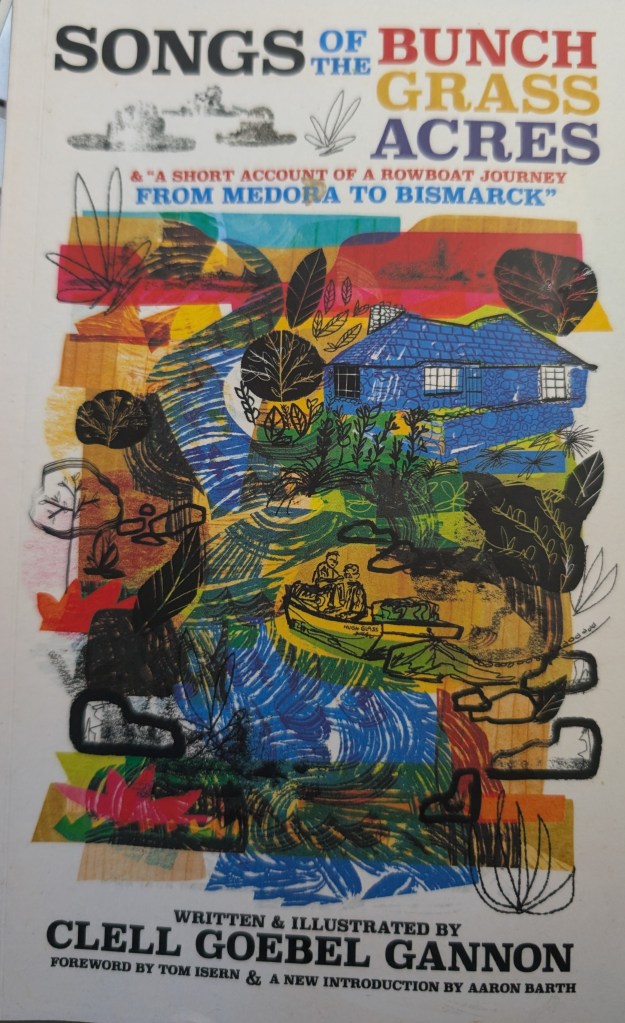
Okay, so I’ve been doing research and writing this on some of the finest days of the year, as summer begins fading into fall. I should be out going for my long daily walks, but I twisted my ankle and it’s been too painful to walk on for a few days, so I’ve been sitting at my computer. And in my recliner, reading a fascinating new book Lillian brought home, Songs of the Bunch Grass Acres, which is a reprint of the poems by North Dakotan Clell Gannon, first published 102 years ago, in 1924. The book has been brought back to life by current Bismarck historian Dr. Aaron Barth.
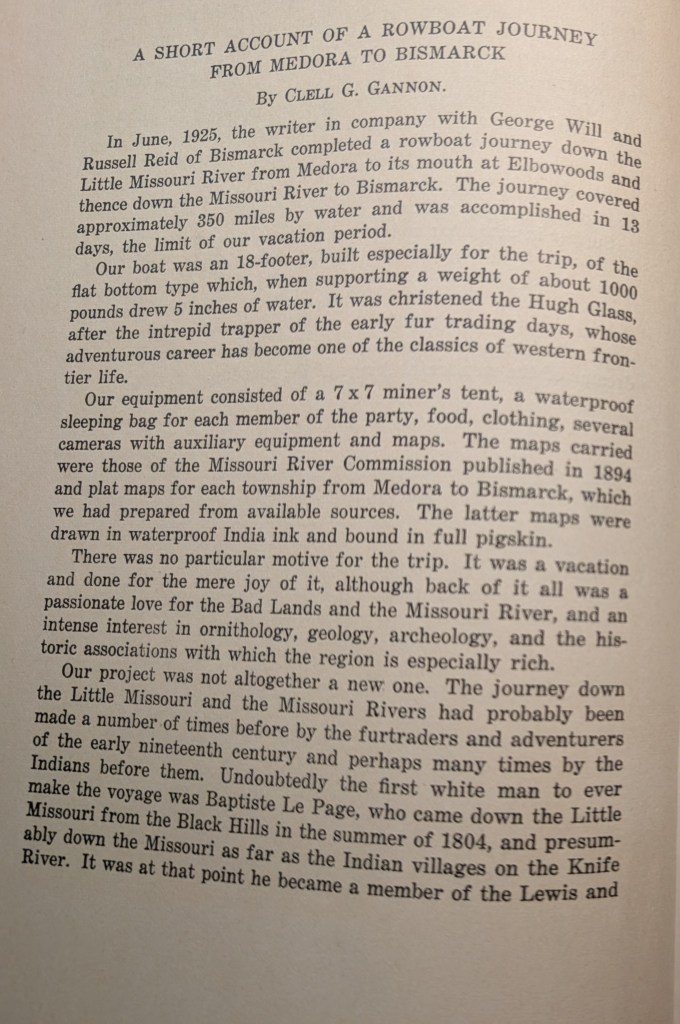
I’ve never seen the earlier book, but I kind of knew about it, because Lillian’s a big Gannon fan, as a result of her research for our upcoming book about another poet, Paul Southworth Bliss, and sure enough, she found the new version for sale at the gift shop at The Landing, run by the Northern Plains Heritage Foundation, where the Lewis and Clark Riverboat docks beside the Missouri River. After a couple of interesting forewords by Dr. Tom Isern and Dr. Barth, the book shares about 40 of Gannon’s poems, mostly about Western North Dakota, and also a recounting of his 1925 Little Missouri/Missouri River boat adventure with George Will and Russell Reid, two more important names out of North Dakota’s past.
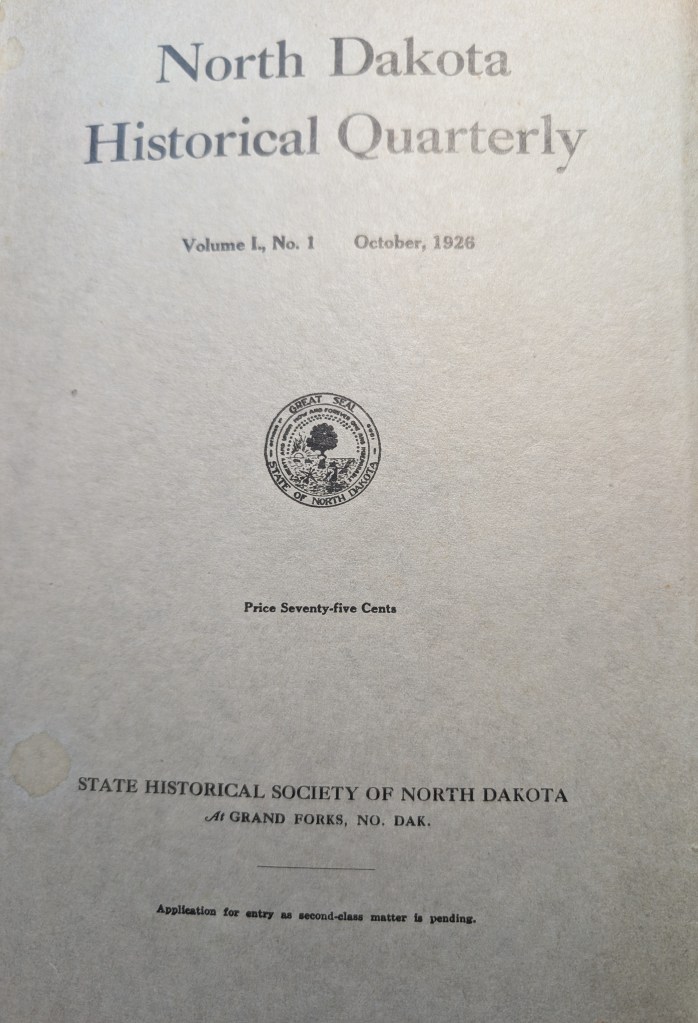
That story first appeared in print in 1926, in Volume 1, Number 1, of North Dakota Historical Quarterly, a publication which will celebrate its 100th birthday in October of this year.
Until now, I never really paid a lot of attention to Gannon’s poetry. My mistake. I am paying a lot of attention to it now. It is wonderful. So I’m going to share one of his poems with you now to end this already-too-long story. I hope you enjoy it as much as I did.
The Badlands Call
By Clell Gannon
Land of a thousand voices
Beckoning unto me,
Land of the zig-zag valleys
Shadowed in history.
Land of a thousand coulees
Pastures without the bars,
Land of a weird beauty
Under a million stars.
Land, I am coming, coming
The sunset shows the way,
Each morning finds a landmark
That wasn’t yesterday.
I am an eager stranger
I’ll find you fresh and new,
You are an open treasure—
What shall I take from you?
Sleep through the dreamless ages,
Mock at the things I say
Scoria buttes and cedars
Now that I come your way.
I shall whisper and listen
I shall look and be still
Hearing the Wind of Ages
Over the storm-swept hill.
I shall survey your canyons
Flashing the blinding heat,
Watch the Little Missouri
Flowing out in retreat.
I shall stop at Medora
Sleeping away its years
Burnt with the sun of summer
Wet in rain-clouds tears.
Take me and call me your brother
I am in love with you,
Cut and scarred are your canyons,
And painted, of so new!
Sagebrush scent on the breezes
Cactus bloom on the sod.
I’m coming, coming, coming
I will be nearer God.


WunnerfulWunnerfulWunnerful ~ now I can give my TwoHoots to those that wanna be a RuinBullion:
“DON’T DO IT”
Thnz 2 MrMrsFuglie!
LikeLike
🙂
LikeLike
Maybe you should contact one of those good Hanson friends, Theodore, who is an undersecretary (read lackey to Dougie Burgum as his wife is Burgum’s assistant) at the Dept. of Agriculture to keep the Roadless Rule in place ….
LikeLike